Apollo.ai
Board management and corporate governance for enterprise.
A board operations platform for regulated organisations. Agenda, real-time voting, legally binding minutes, and an auditable decisions log — all in one product. Live across OMV, PwC, Verbund, and a roster of European enterprises.
- Enterprise
- SaaS
- Flutter
- Node.js
- Governance
- Real-time
Three things Apollo.ai changed about board operations.
A single source of truth
Agendas, documents, votes, minutes, and decisions all live in one place with proper access control. The chain from proposal to follow-up is unbroken.
Real-time voting with an audit trail
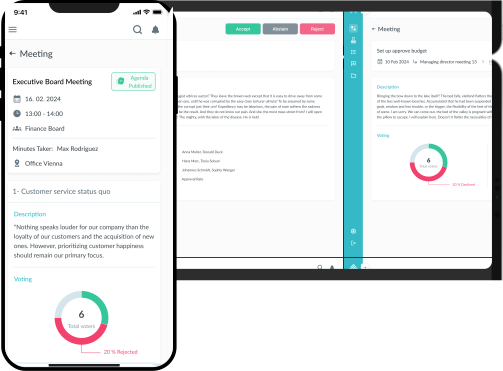
Every vote is recorded against the agenda item it resolves — with unanimity, date, board, and outcome. A compliance manager can find any decision in seconds.
Decisions that actually happen
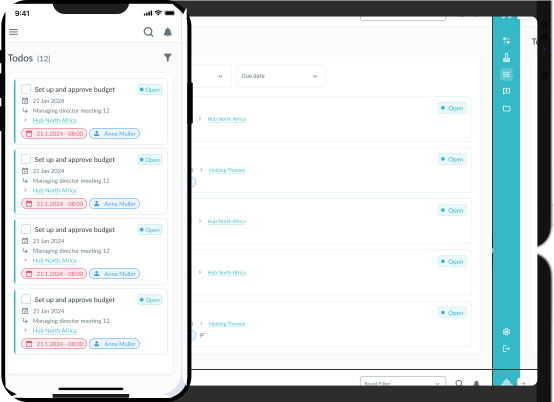
Action items, owners, and follow-up are wired into the platform. A month after a meeting, the board can confirm exactly what was agreed and where it stands.
The Problem
A board meeting produces decisions. Those decisions need to happen, and someone needs to make sure they do. The chain from agenda to meeting to decision to follow-up was broken at almost every point for most organisations.
Agendas were sent by email. Documents lived in shared drives with no real access control. During meetings, voting happened by show of hands or verbal confirmation with no record attached to the agenda item. After meetings, minutes were written up separately by hand, sent around for corrections, chased for signatures, and stored in a folder that was hard to find later. Action items were noted in spreadsheets that nobody updated.
Decisions that were made in a meeting often went nowhere. A month later, nobody could confirm whether a resolution was acted on, who was responsible, or what the board had actually agreed to. For large regulated organisations, this is not just an efficiency problem, it is a compliance problem. An auditor asking for evidence of a governance decision should not receive a chain of emails.
Two codebases, one product: Flutter for every board surface, Node.js for the engine that runs them.
Apollo.ai is two different codebases, two different skill sets, and two engineering concerns. The complexity lives in both layers, and crucially in how they work together correctly across five user types, multiple organisations, real-time voting, and legally binding document workflows.
ETechViral built the complete product: every mobile and tablet screen in Flutter, the Node.js backend, the real-time voting engine, the circular resolution workflow, the minutes generation and sign-off pipeline, the file storage module, the decisions log, the audit trail, and the multi-board permission system, from first line of code to live deployment.
- Flutter
- Dart
- Node.js
- TypeScript
- Real-time engine
- PostgreSQL
- Role-based access
- E-signatures
- Audit trail
- Cloud storage
Proposals
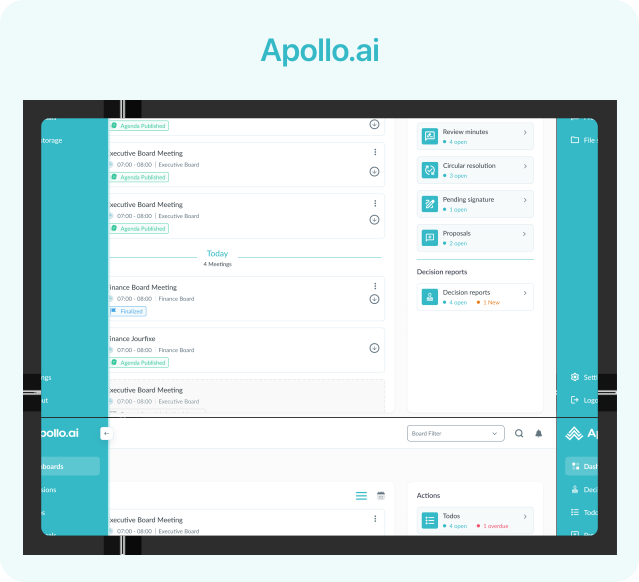
A proposal is a structured object: title, type, duration, the person who proposed it, the people it involves, and a status. Proposals sit in a queue and move to Approved when the relevant person confirms they belong on the agenda. The paper trail for how an agenda item reached a meeting exists in the platform.
Structured: Every proposal carries title, type, duration, proposer, involved parties, and lifecycle status.
Queued workflow: Proposals sit in a queue and only reach the agenda once the right reviewer confirms.
Traceable: The full chain of how an agenda item reached a meeting is queryable inside the platform.
Decisions log
Every vote outcome is recorded in the Decisions log the moment it closes. Each record shows the resolution text, whether it was unanimous, the date, the board, the meeting, and the status: Approved, Rejected, or Undecided. The log is filterable and linked directly to the agenda item and the meeting it came from. A compliance manager or auditor can find any decision in seconds.
Auto-recorded: Outcomes commit to the log the moment a vote closes. No manual write-up, no missed entries.
Full context: Resolution text, unanimity, date, board, meeting, and status against every entry.
Audit-friendly: Filterable log linked to agenda items and the meeting they came from. Any decision is findable in seconds.
Building enterprise-grade governance across two codebases
Five user roles, one product
Board members, secretaries, compliance officers, observers, and admins each see a different surface of the same product. The permission system enforces that strictly without making the product feel fractured to any one of them.
Real-time voting that holds up to audit
Live voting is easy until every result has to be legally defensible. Each vote ties to the exact agenda revision, with timestamps, role attestation, and an immutable record, even when participants drop and reconnect mid-session.
Legally binding document workflows
Minutes and circular resolutions are signed and stored as legal records. The sign-off pipeline includes version control, e-signature flows, chain-of-custody tracking, and the audit trail compliance teams actually rely on.
Apollo.ai is live and in active use by enterprise clients across Austria and Europe. The platform reports more than 10 hours saved per meeting, 25% more decisions followed through to completion, and a 4x improvement in decision implementation rate. The clients using it — OMV, PricewaterhouseCoopers, GETEC, DORDA, All for One, Verbund, Salzburg AG, CERAFILTEC, Ventocom, and Stadtwerke Klagenfurt — are large regulated organisations with strict requirements for data security, compliance documentation, and governance process integrity. The platform handles their board operations end to end.
Got an idea worth building?Let's ship it.
Free 30 minute discovery call. We talk through what you're building, the constraints, and whether I'm the right fit. No pitch.