DentaSmart
Know what's happening in your mouth.
Upload a photo of your teeth or X-rays and get clear AI insights in minutes, with an easy plan to prevent expensive surprises.
- AI
- CNNs
- Transfer Learning
- Flutter
- Mobile
The Problem
Most people do not go to the dentist until something hurts. By then, the problem is already serious and the treatment is expensive. The reason is not laziness. It is that people cannot see what is happening inside their own mouth, and when they do visit a dentist, the terminology and the X-rays make no sense to them. They leave confused, agree to whatever is recommended, and often feel they paid too much for something they did not understand.
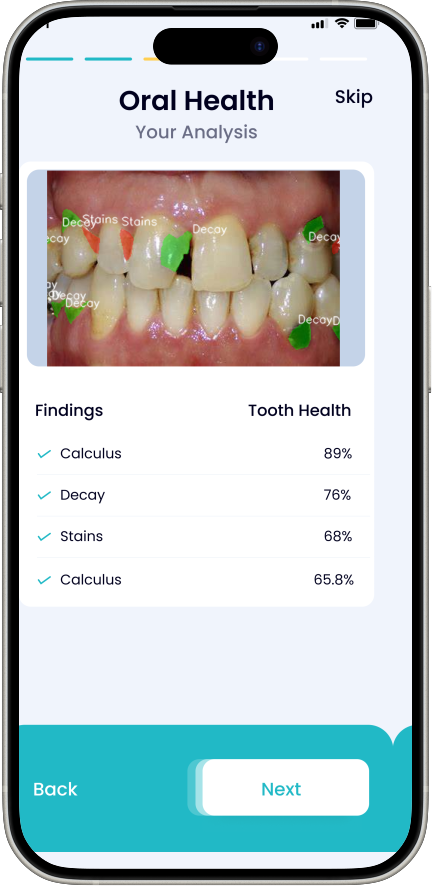
The client wanted to build a product that gives people a way to understand their own dental health. The idea: a person takes a photo of their teeth or uploads an X-ray. An AI analyses the image and explains what it sees in plain language. The user gets an Oral Health Score, a list of things that need attention, and guidance on what to ask the dentist about. The app does not replace the dentist. It prepares the user for the visit so they are not walking in blind.
X-Ray Analysis with Transfer Learning
Transfer Learning and Convolutional Neural Networks enhance dental X-ray analysis. Pre-trained models like VGG16 and ResNet are adapted to our specific needs to quickly and accurately identify cavities, decay, and gum disease.
Pre-trained models: VGG16 and ResNet are adapted to specialise in dental diagnostics.
Adaptation process: Fine-tuning the final layers of these models so they specialise on dental imagery.
CNN Dental X-rays Analysis: Detection & Classification
CNNs detect patterns in dental X-rays, identifying conditions such as cavities, decay, and gum disease, with significantly more accuracy and efficiency than traditional inspection.
Role of CNNs: Detect patterns and classify conditions across dental imagery.
Why it wins: Higher accuracy and faster diagnosis than traditional methods.
Conditions covered: Cavities, dental decay, gum disease, and the list keeps growing.
Three problems that made this hard to build
A 3D teeth model inside Flutter
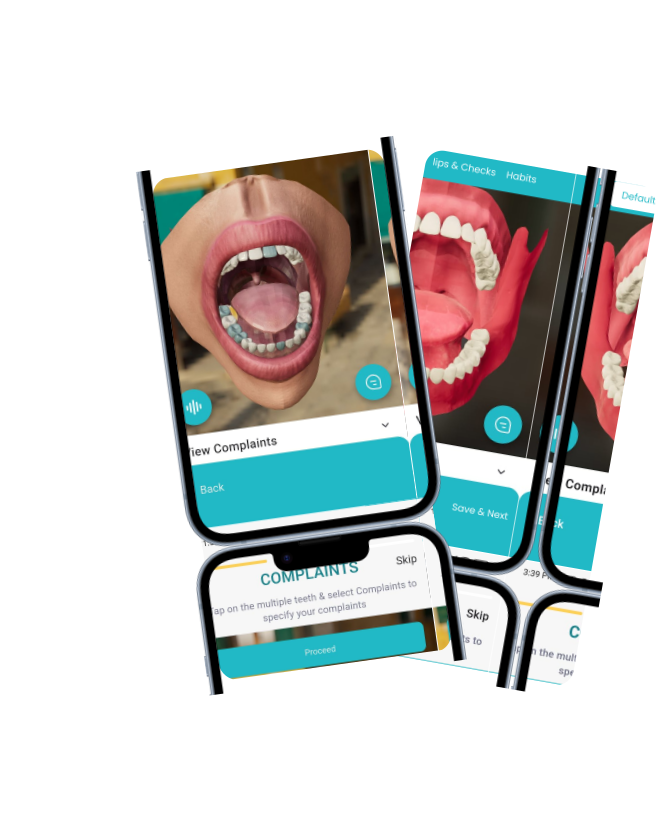
The client wanted a 3D model of a full set of teeth (upper and lower jaw) that users could rotate, zoom, and tap on to select individual teeth or areas where they felt pain. Flutter has no built-in 3D rendering engine and no widget that draws a realistic 3D teeth model. This had to be built in native code.
Training AI on real dental imagery
The AI that analyses dental photos and X-rays had to be trained on real dental data. The model needed to detect cavities, gum recession, discoloration, bone loss, and other conditions from a photo taken on a phone camera, not from a clinical imaging device. Training this model was a separate ML engineering problem from building the app that uses it.
Drawing the line between AI and human
The app needed to handle a situation most health apps ignore: when should the AI give a direct answer, and when should it say “you need to see a dentist for this”? Getting this wrong in either direction is dangerous. Too confident and the user skips a visit they needed; too cautious and the app feels useless.
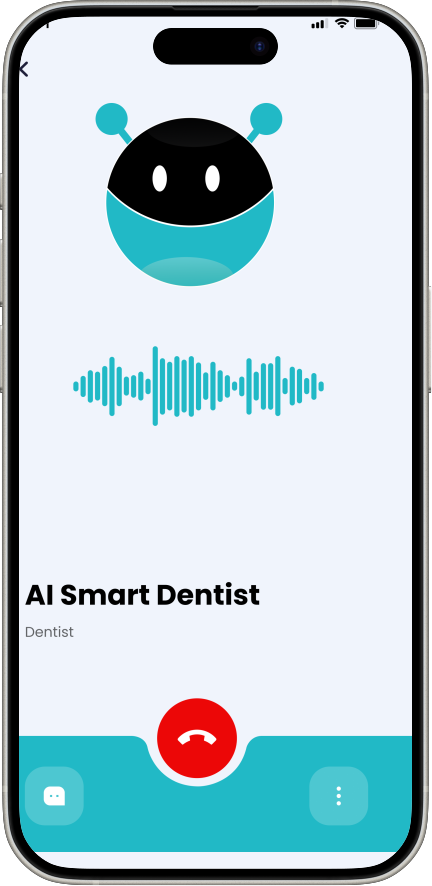
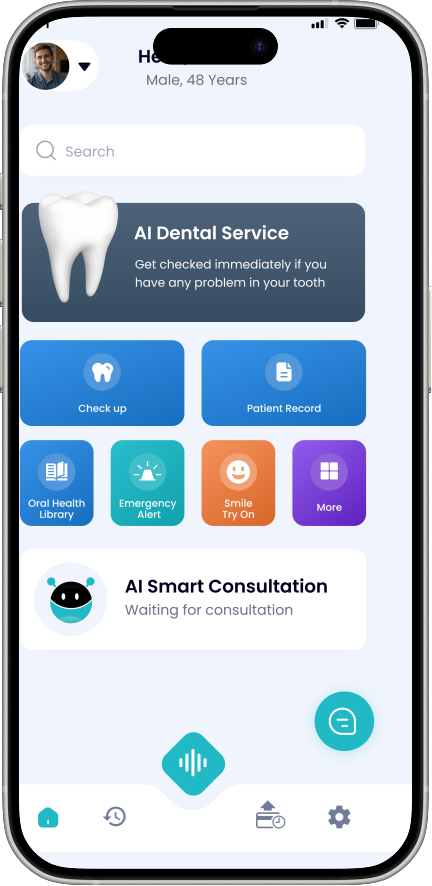
DentaSmart empowers users to take control of their dental health with precise AI-driven analysis of mouth images and X-rays. A built-in AI chatbot guides users through the app and dental care best practices, while real-time graphs give an immediate read on overall dental health, making it easier to stay informed and proactive about oral hygiene.
Got an idea worth building?Let's ship it.
Free 30 minute discovery call. We talk through what you're building, the constraints, and whether I'm the right fit. No pitch.