Finden
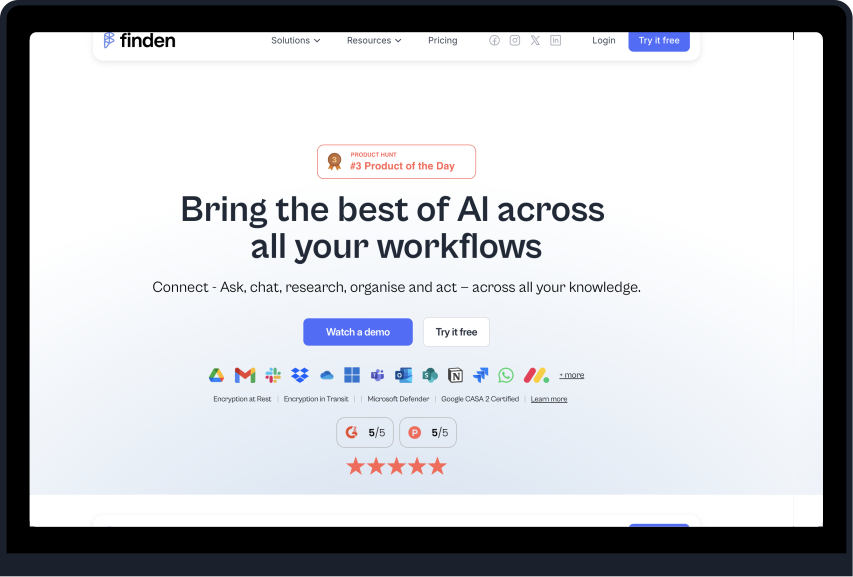
Bring the best of AI across all your workflows.
Connect, ask, chat, research, organise, and act, across all your knowledge. All your apps, documents, and data in one secure, intelligent workspace.
- AI
- Vector Search
- Flutter
- Firebase
- Google Cloud
- OAuth
- Cross-platform
All your apps, documents, and data in one secure, intelligent workspace.
Make decisions faster
Finden cuts through the noise and highlights what actually matters, so you can move forward with confidence instead of second-guessing.
See what matters
All your scattered information in one clear view. Finden shows you exactly what's working and what needs attention.
Stay organised automatically
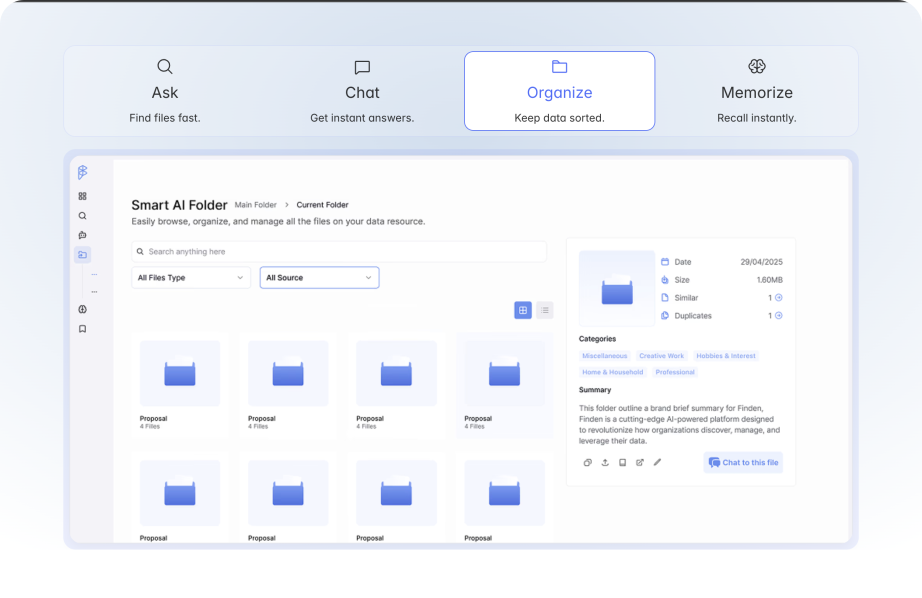
Your data stays organised, key details are remembered, and you can find what you need instantly while you focus on growing your business.
The Problem
Most people who work on a computer have the same problem: their files are everywhere. A document started in Google Drive. A version of it shared over WhatsApp. A related spreadsheet in OneDrive. An email about it in Gmail. A comment on it in Slack. When they need to find something, they open four apps, search in each one separately, and still are not sure they found the right version.
It gets worse when someone manages multiple accounts. A person with two Google accounts (one personal, one work) has two separate Drives that do not talk to each other. Searching across both at the same time is not possible natively. The same problem exists for teams: different people save things in different places, and there is no single place to look.
The client identified this as a problem worth building a product around. The question was: can you give someone one place where all their connected storage lives, and let AI handle the work of finding and organising, a workspace where you connect your storage services once, and after that you can search, ask questions, and organise files across all of them from a single interface.
A full Flutter app on three platforms, with a Firebase + Google Cloud backend.
Built the full Flutter application for mobile and web, plus the Firebase and Google Cloud backend.
Flutter runs the frontend across all three platforms from a single Dart codebase. Firebase handles authentication, the database, and server-side functions. Google Cloud hosts the AI model and the vector search infrastructure that powers the semantic file search. Kotlin and Swift handle the one thing Flutter cannot do natively: watching local folders on the device for file changes.
- Flutter
- Dart
- Firebase Auth
- Firestore
- Cloud Functions
- Google Cloud
- Vector Search
- Kotlin
- Swift
Ask questions and get answers
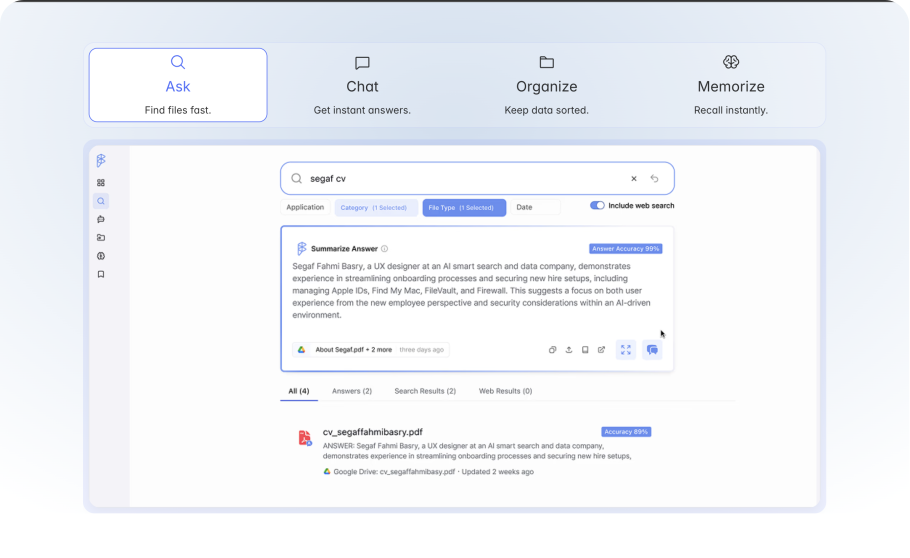
The user can ask questions in plain language (“what is the status of the Singapore proposal?” or “find the invoice from last November”) and get an answer with the relevant files attached. The AI reads the indexed content and returns a direct answer, not just a list of files to open and check manually.
Watch local folders
The user picks a folder on their phone or computer and Finden watches it. Any file added is indexed automatically. Changes to existing files update the index. The folder behaves like a connected source the same way a cloud drive does, the only difference is that it lives on the device.
What made this build complex
Connecting a dozen third-party services, each with its own OAuth flow
Finden integrates with Google Drive, Gmail, OneDrive, SharePoint, Microsoft Teams, Dropbox, Slack, Jira, Confluence, Notion, WhatsApp, and Outlook. Each has its own authentication system, API, data model, and rate limits. Every integration had to be built, tested, and maintained separately, tokens stored securely, refreshed when they expire, and revoked cleanly when the user disconnects. If a refresh fails silently, the user gets stale results and no error message. Getting this right across a dozen services is ongoing engineering work, not a one-time task.
Multiple accounts for the same service
Real users often have two Google accounts, personal and work. Finden supports connecting multiple accounts from the same provider, which means token storage, the indexing pipeline, and the search system all have to handle the same user having two separate Google Drive connections simultaneously without mixing data between them.
Watching folders on the local device
Finden watches folders on the user's local device and indexes their contents. When a file is added, changed, or deleted, the index updates automatically. Flutter's file APIs can read files but cannot register a listener that fires when the file system changes. This required writing native platform code in Kotlin and Swift.
Why this needed native code
On Android, the native FileObserver class watches a directory and fires callbacks for create, modify, delete, and rename events. Flutter has no equivalent. The Kotlin layer handles the watching and sends structured events to Flutter over a MethodChannel. The same pattern was implemented in Swift using NSFilePresenter on iOS, the reason Kotlin and Swift sit in the tech stack despite the app being built primarily in Flutter.
Semantic search across different file types and sources
A basic keyword search returns files where the search term appears in the file name or content. Finden's search goes further, you can ask a question in plain language and it returns the right files even if they don't contain those exact words. A query like “show me the Q3 budget discussion” finds the right file even if it's called “Finance Review Oct.pdf”. This works through vector search: when a file is indexed, an AI model on Google Cloud converts the content into a numerical representation of its meaning. Files with similar meaning come up, not just files with matching words.
AI queries that never touch the user's data
Finden's AI runs queries against the user's files without those files ever being sent to a shared AI model. Queries go to a private AI model. The documents themselves are never stored on Finden's servers in a way that could be used for training.
Google CASA Tier 2 security certification
CASA (Cloud Application Security Assessment) is a third-party security audit run by a lab approved by the App Defense Alliance. Passing CASA Tier 2 means an independent security firm has reviewed the application's integration with Google APIs, tested it against a defined set of security requirements, and confirmed it meets those requirements.
Running on three platforms from one Flutter codebase
Flutter can run on iOS, Android, and web from a single Dart codebase, but that does not mean the same code works identically without any platform-specific handling. The web build has different rendering constraints from the mobile builds. File picker behaviour differs between web and mobile. The OAuth redirect flow differs on web because there is no app scheme to redirect back to.
Finden is live on iOS, Android, and web, with over 300,000 documents indexed across its user base. It has passed the Google CASA Tier 2 security audit and holds the Microsoft Defender partnership. User reviews on Product Hunt and G2 consistently mention the same three things: finding files faster, managing multiple accounts in one place, and searching WhatsApp alongside cloud storage.
Got an idea worth building?Let's ship it.
Free 30 minute discovery call. We talk through what you're building, the constraints, and whether I'm the right fit. No pitch.